
Buying a tourbillon watch is different from choosing an ordinary mechanical watch. The complication can dominate both the engineering and the design, but the presence of a rotating cage alone does not tell you whether a watch is well made, enjoyable to wear or sensible to own.
A better approach is to evaluate the tourbillon as part of the whole watch: movement architecture, finishing, proportions, serviceability, warranty and the character of the piece itself.
1. Decide what attracts you to the tourbillon
Start with the reason you want one. Some collectors are drawn to the history and classical engineering. Others want an open mechanical display, hand finishing, unusual architecture or simply the hypnotic motion of the rotating cage.
There is no wrong motivation, but identifying it helps narrow the field. A restrained dress watch with a traditional tourbillon offers a very different experience from a skeletonized flying tourbillon or a multi-axis showpiece.
If you want to understand the mechanism first, read What Is a Tourbillon? How It Works and Why It Matters.
2. Understand the tourbillon architecture
Terms such as traditional, flying, multi-axis, inclined and dual tourbillon describe meaningful differences in construction. They should not be treated merely as marketing labels.
A flying tourbillon removes the upper bridge for a more open presentation. A multi-axis tourbillon changes the orientation of the regulating organ around more than one axis. A dual tourbillon uses two regulators. Each approach creates different engineering, aesthetic and servicing considerations.
Our guide to tourbillon types provides a detailed comparison, while Flying Tourbillon vs Traditional Tourbillon focuses on the two most commonly compared constructions.
3. Look at the movement, not only the complication
A tourbillon should not distract from the rest of the calibre. Look at how bridges, plates, wheels and the regulating system are laid out. Is the movement designed coherently around the complication, or does the tourbillon feel visually isolated from the rest of the watch?
Finishing matters too. Depending on the price and philosophy of the watch, you may find polished bevels, brushed surfaces, hand engraving, skeletonized bridges, decorative screws or more industrial finishing. None of these details should be judged in isolation; what matters is whether the execution is consistent with the watch and its price.
4. Manual winding or automatic?
Many tourbillons are manually wound, which can make the movement thinner, provide a more open view through the caseback and create a stronger daily interaction with the watch. Automatic tourbillons add the convenience of a self-winding system but must integrate a rotor and additional winding components into an already complex movement.
Neither is inherently better. If you rotate several watches, a long power reserve may matter more than automatic winding. If the ritual of winding is part of the appeal, a manual calibre can be especially rewarding.
5. Consider how the tourbillon is displayed
Some watches reveal almost the entire calibre, while others keep the tourbillon as a focused aperture within a conventional dial. Skeletonization can be spectacular, but more visible mechanics do not automatically mean better mechanics.
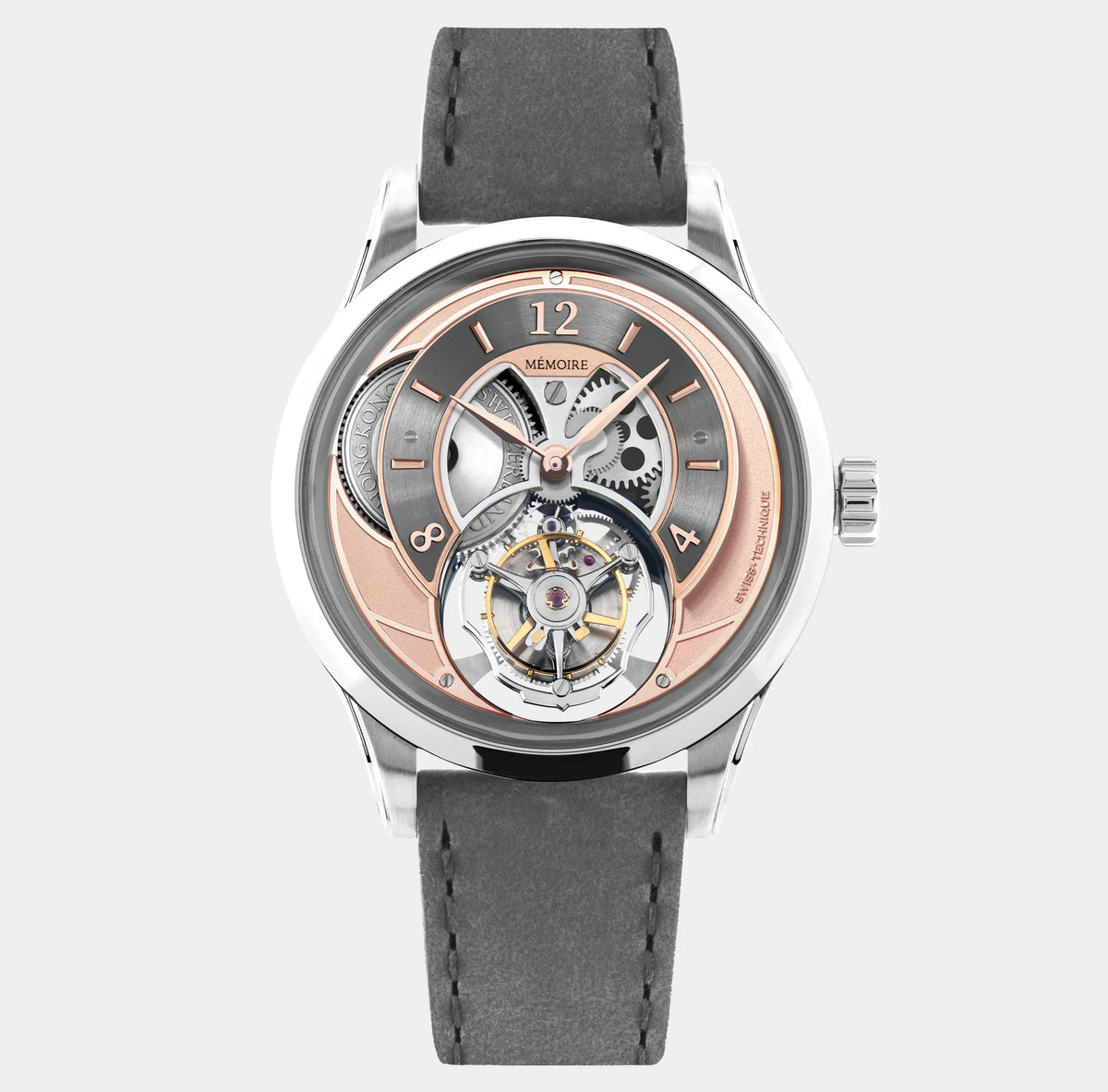
Ask whether the display improves legibility and design or competes with them. The Mémoire Aspirare, for example, takes an intentionally openworked approach where the movement architecture is a major part of the watch’s visual identity.
6. Check case size and wearability
Tourbillon movements can lead to larger or thicker watches, particularly when combined with additional complications or elaborate case construction. Dimensions on paper only tell part of the story.
Case diameter, thickness, lug shape, lug-to-lug length, crown position, weight and strap geometry all affect comfort. A 43 mm watch with compact lugs may wear better than a smaller watch with long straight lugs.
Think about how often you intend to wear it. A mechanically dramatic watch that feels awkward on your wrist will spend more time in the box than one that fits your lifestyle.
7. Evaluate practical specifications in context
Power reserve, water resistance, crystal material and strap or bracelet construction matter even on highly complicated watches. Their importance depends on how the watch will be used.
A longer power reserve can be useful on a manually wound tourbillon. Sapphire crystals can provide scratch resistance and an unobstructed view of the movement. Water resistance can increase everyday practicality, but a tourbillon should never be assumed suitable for water exposure without checking the manufacturer’s stated rating for that specific model.
8. Think about service before you buy
A tourbillon contains a delicate rotating assembly and should be serviced by people with the correct movement knowledge, parts access and equipment. Before buying, ask who supports the watch, how warranty work is handled and where future servicing can be performed.
This is particularly important with independent manufacturers. Interesting movement architecture is a strength only if the watch can also be supported over time.
Tourbillon Timepieces is an authorized retailer for the brands we represent, and watches are supplied with the applicable manufacturer’s warranty. Warranty periods and conditions can vary by brand and model, so they should be checked for the specific watch you are considering.
9. Separate price from value
Tourbillon pricing spans a very wide range. Price can reflect movement development, finishing, materials, production volume, brand positioning, handwork and other complications, but a higher price does not automatically make a watch the right choice for you.
Compare what is actually being offered: movement architecture, decoration, originality, case construction, rarity, manufacturer support and the emotional appeal of the watch.
We also recommend avoiding the assumption that a tourbillon is automatically an investment. Mechanical watches should primarily be purchased because you value the object and want to own it; future resale performance is uncertain.
10. Buy the watch, not the specification sheet
A specification such as “flying tourbillon” or “72-hour power reserve” is useful, but the best tourbillon watches are more than a list of technical features. Look for a design that makes sense as a whole and a movement you still want to study after the initial novelty has worn off.
A practical tourbillon checklist
- Which type of tourbillon does the movement use?
- Who designed and manufactures the calibre?
- How is the movement finished?
- Is the watch manual or automatic, and what is its power reserve?
- Do the case dimensions suit your wrist?
- Are water resistance and crystal specifications suitable for your intended use?
- Who handles warranty and future servicing?
- Is the manufacturer likely to provide parts and technical support?
- Does the price make sense relative to the execution and originality?
- Most importantly: would you still want the watch if the tourbillon label were removed from the sales pitch?
Explore tourbillon watches
Once you know what matters to you, compare different movement architectures and design philosophies in our tourbillon watch collection. The right tourbillon is not necessarily the most complicated one; it is the watch whose engineering, design and ownership experience fit what you value as a collector.

Leave a comment
All comments are moderated before being published.
This site is protected by hCaptcha and the hCaptcha Privacy Policy and Terms of Service apply.