
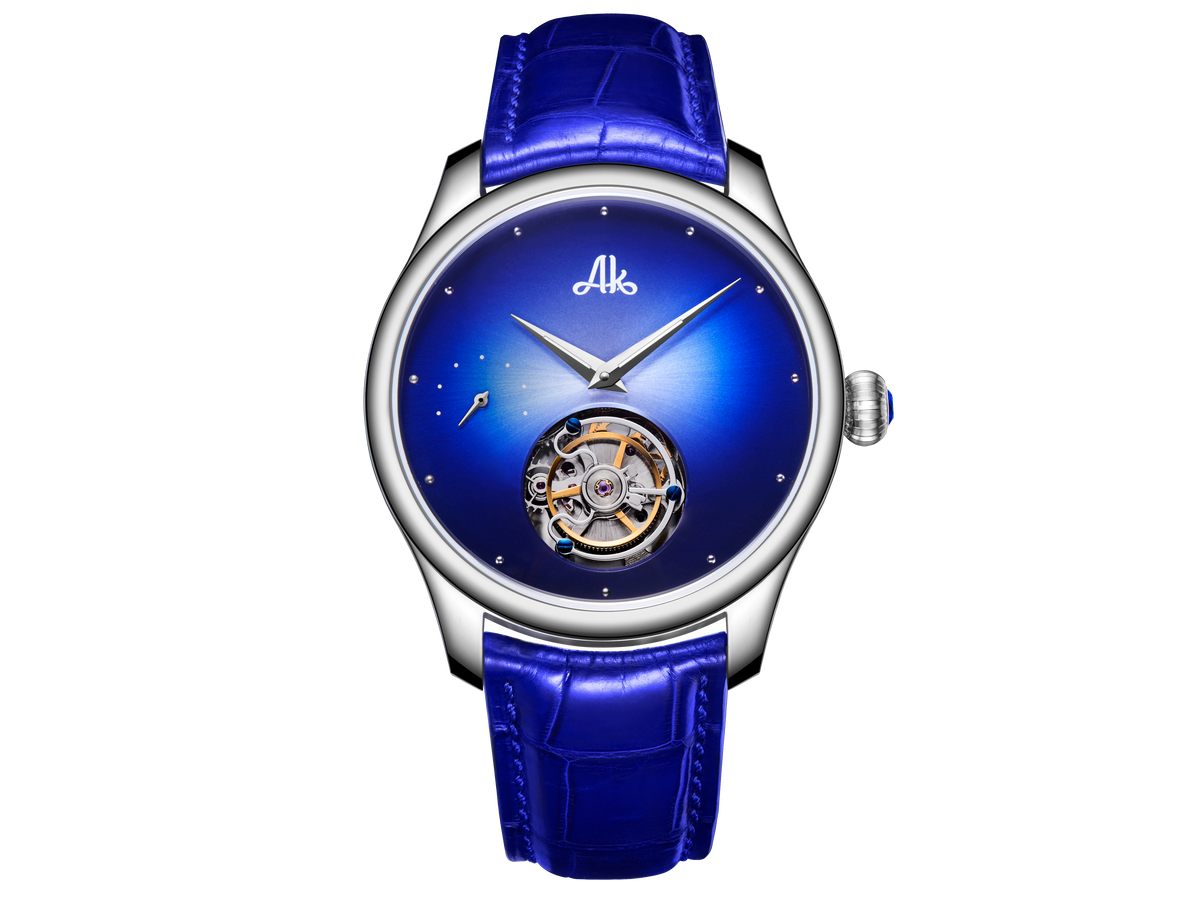
At first glance, a traditional tourbillon and a flying tourbillon can look similar: both place the regulating organ and escapement in a cage that rotates as the watch runs. The key difference is not the basic tourbillon principle, but how the cage is supported.
That structural change has a major effect on appearance and movement design, which is why “flying tourbillon” has become one of the most recognizable terms in contemporary mechanical watchmaking.
What both tourbillons have in common
In both constructions, the balance and escapement are carried by a rotating cage. The purpose of the original tourbillon concept was to average positional rate errors that could affect the regulating organ, especially in pocket watches that spent long periods in vertical positions.
For a broader introduction, see What Is a Tourbillon? How It Works and Why It Matters.
How a traditional tourbillon is supported
In a conventional tourbillon, the cage is generally supported at both sides. An upper bridge spans the tourbillon and provides a bearing above the cage, while a lower support sits beneath it.
The bridge is functional, but it is often decorative as well. In high-end finishing, the shape, polish, bevels and overall execution of that bridge can become part of the visual identity of the watch.
A well-executed traditional tourbillon can therefore be extremely expressive even though more of the mechanism is visually framed by its support structure.
How a flying tourbillon is different
The flying tourbillon removes the upper bridge and supports the cage from one side, typically from below. The construction was developed in Glashütte by Alfred Helwig and his students in 1920.
Because there is no bridge crossing the top of the cage, the mechanism is less obstructed when viewed from the dial side. The cage seems to rotate freely in space, which explains the term “flying”.
The Astbury & Kent Stellaris AK735S, for example, uses a flying tourbillon as a major visual focus of its open mechanical design.
Is a flying tourbillon a multi-axis tourbillon?
No. This is one of the most common points of confusion.
Flying describes the support architecture. Multi-axis describes rotation around more than one axis. A flying tourbillon can be a conventional single-axis mechanism, while a multi-axis tourbillon may use a completely different support structure.
Our guide to the different types of tourbillons explains these categories in more detail.
Does a flying tourbillon keep better time?
Not automatically. Removing the upper bridge changes the construction and visual presentation, but the word “flying” is not a guarantee of superior accuracy.
Chronometric performance depends on the complete movement: balance and hairspring design, cage mass, gearing, adjustment, power delivery, manufacturing tolerances, shock resistance and many other factors. Two watches using different tourbillon architectures can therefore perform very differently in practice.
It is better to evaluate the specific calibre than to assume one tourbillon category must be more accurate than another.
Is a flying tourbillon more complex?
Both forms are complex. A flying construction places particular demands on the one-sided support, bearings and cage because the mechanism must remain stable without the upper bridge. At the same time, complexity alone is not a useful measure of quality.
A beautifully engineered traditional tourbillon can be more sophisticated in its overall movement architecture than a simpler flying tourbillon, and vice versa.
Visual character: open versus architectural
The biggest difference for many collectors is visual.
A flying tourbillon offers a clear, uninterrupted view of the rotating cage. This can work particularly well in skeletonized, contemporary or highly sculptural watches. A traditional tourbillon, meanwhile, exposes the bridge and its finishing, creating a more visibly architectural presentation.
Neither approach is inherently more attractive. The better choice depends on whether you value an unobstructed view of the cage or the visual detail of a classically supported mechanism.
What should a collector consider?
When comparing the two, look beyond the label. Consider the quality of the movement, finishing, power reserve, case proportions, service requirements, warranty support and how comfortably the watch fits your wrist and collection.
Also consider whether the tourbillon feels integrated into the design. The strongest watches make the complication part of a coherent movement and dial architecture rather than simply placing a rotating cage at six o’clock.
Flying or traditional: which should you choose?
Choose a flying tourbillon if the unobstructed mechanical display and sense of motion are central to what attracts you. Choose a traditional tourbillon if you appreciate classical construction and the additional opportunity for bridge finishing and architecture.
In either case, execution matters more than the category. For a broader buying framework, read our collector’s guide to choosing a tourbillon watch, or browse our tourbillon watch collection.

Leave a comment
All comments are moderated before being published.
This site is protected by hCaptcha and the hCaptcha Privacy Policy and Terms of Service apply.